Sunday, 28 August 2011

Dress Up with The Crunkle; War; New Songs

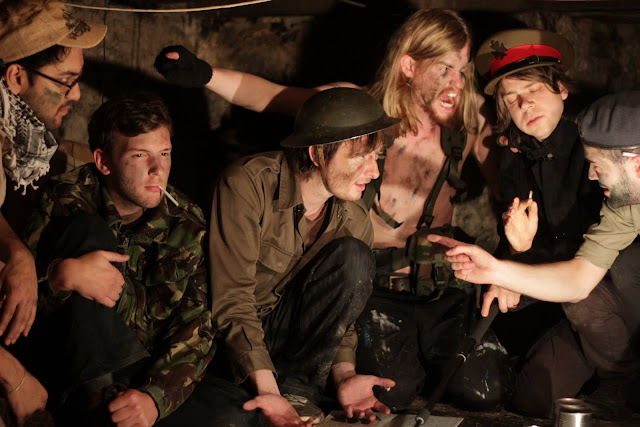
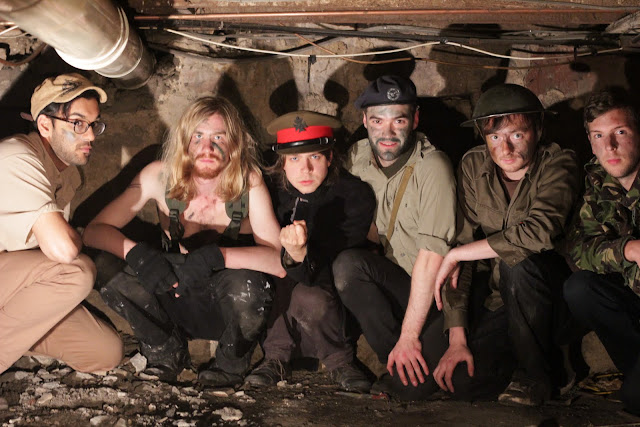
So we’ve been photographing ourselves.  It’s apparently a necessity, and the attempts in the past have been so disastrous we decided to take the matter into our own hands.  Kind photographers have made heroic efforts at trying to not make us look like a bunch of dorks….to no avail.  See exhibits a b and c

(Hmmm I can't work out how to embed exhibit b, but it's pretty hilarious - it's in the photo part of this review of limbo, go have yourself a wee chuckle at my dreadful hair and our bizarre expressions...)


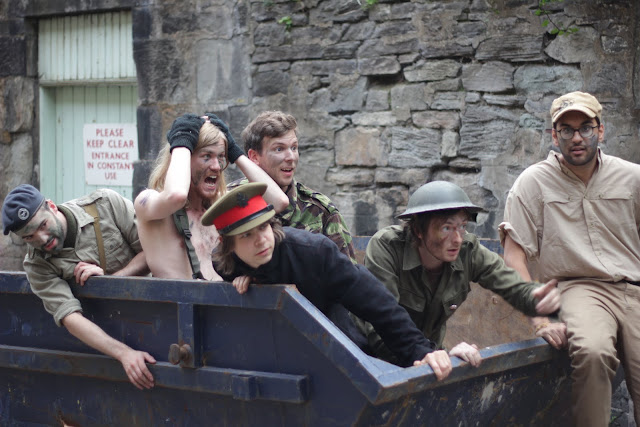
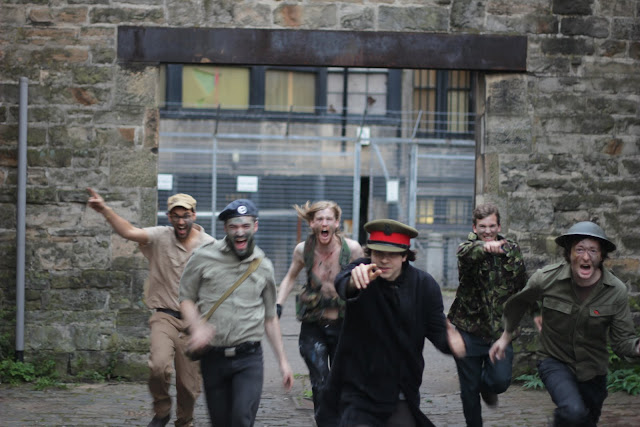
I assure you we’re some hot ass in real life, we just aint that photogenic. To circumvent this problem – well - we did what all ugly and uncool people have done throughout history: dressed up as soldiers and fannyed around.  Check it out!


So much fun.  Haven't played dress up in a long long time and we all regressed to a playground mentality.  That's why we're in that there skip.  Sure, they kind of look like we play too much Warhammer, but we're all dead chuffed with how it turned out.  

They were taken by our good friend The Crunkle, a strange and lank figure who refuses to bend his spine.  Quite talented, though – if you follow him on the old twitter (@elwinkingman) you can find out what he’s up to.  He’s just directed a series of films about dresses based on horrific diseases, an event he’s celebrated by ordering a big pack of business cards.

And we got new songs for the album up, just up there – download them for free, play them at parties, have a wee cry etc etc.

WAR!
Al xxx


Thursday, 30 June 2011

News, with Guitar Solos

Every band has to always be asking itself the question: are they as good as AC/DC?  The point isn't that you'll ever be AS good, but it's a great little technique to help you grow some balls.  Seems like we've grow a little lax with this vital thought experiment, and when some nutter got in touch with us on the internet with that very question we were fairly taken aback.

One thing they have which we don't?  Face-melting mother-fucking four-by-four piece-of-cedar ass-whooping metal-on-metal heavy-ass guitar solos.  Well not anymore folks.  Not anymore.  We've done a wee number that's got one which will drive you INSANE with the full force rocking.  I lie awake at night asking myself the question how we let ourselves get by without one for so long.  Perhaps this is the reason people have always been calling us a folk band. 

In other important news, we're playing the Scottish Parliament on friday around half four to celebrate it's opening, and then on saturday we'll be kicking wir jams at the Pyramid Stage of Kelburn Garden Party in the later part of the evening.

To celebrate these wonderful events why not have a listen to some tasty-fine noodling from the greats.  

1) The Boss and Morello


OF COURSE you work for him.  You just don't know it yet.

2) Prince


Watch him at the end send the guitar back up to heaven, it's work on earth now being done.

3) Metallica


A great example of a guitar playing a man, rather than the traditional method of it being the other way around.

3) David Gilmour


Basically, Waters - fuck off.

4) And finally...Slayer


The annihilation of the earth itself?  The sound of the triumph of the hordes of hell?  No!  A guitar solo!

PIECE OF CEDAR!
Al


Monday, 27 June 2011

Take Some Thought For The Artwork


With our debut album 'Take No Thought For Tomorrow' well and truly released, I thought it'd be cool to say a word or two about the artwork which accompanies it, which as it goes we're all incredibly proud of.  Firstly, it might be useful to look at what album artwork is (woah) as an ever evolving medium, the importance of which, I think, has steadily diminished since the move away from vinyl LPs.  I'm not one to harp on about how vinyl 'just sounds better' – it doesn't - but aesthetically I sympathise with those who yearn for those poster sized panels to accompany their laps.  For me, it's always been something to gaze at and puzzle over, while diving into the music - all part of the ritual of getting hold of your favourite band's new CD.  In this sense it was partly the scale of the LP cover which contributed to the success of the vinyl's iconic place within pop culture.  For decades, more than any other recorded medium, vinyl sleeves were the lenses through which popular music was perceived.  Album artwork was the non-musical medium by which musicians mass communicated with their fans and in the global marketplace.  Billboards almost, they were made to stand out while being riffled through and picking over by fans eager to learn about Bowie or The Beatles' latest aesthetic, musical and conceptual identity.  Even before you heard the music, you were left with an impression about the album you'd just bought, hulked under your arm on the bus home, be it the busy collage of Sergeant Pepper or the blank, unassuming 'White Album',  The LP sleeve offered artists a platform for their mission statement.  


With the rise of MTV and the music video, this entirely changed.  Michael Jackson now had 20 minutes of cinema time to play with, as advertising and artwork began to merge ever more deceptively in the mainstream eye, subsuming the album artwork as the visual medium.  The CD of the 90s diminished the role of artwork even further: no longer could you stick album artwork on your wall, you needed a magnifying glass to figure out what you were looking at.  And finally, with the development of the mp3, artwork is left as an optional part of a download, rendering it an essentially unnecessary part of the modern listening experience.  As a young mosher though, in the glory days of the late 90s/early 00s, I remember artwork playing a pivotal role in my relationship to the music I consumed.  Call it vain, but I was definitely more turned on by bands who seemed to pay attention to their public image to an extent.  Before Kerrang TV, a lot of the bands I listened to weren't on MTV, so again artwork became an important part of conveying an aesthetic message within the confines of the 'alternative and metal' section in HMV.  Because of this there seemed to be a new attempt to fill this void.  Tool built 3D glasses into their packaging for example.  Radiohead offered large special edition CDs within hardback books which expanded visually on the lyrical themes.  More than this, these bands went further, and presented something which I think, could stand alone as 'art' as well as packaging.  Of course the USB drive is still the future, but an awareness and attention to detail was displayed by these bands which helped emphasise an artistic vision and totality which I (perhaps shallowly) responded to.  I found this exciting, immersive and indicative of a certain commitment to making great music.   Looking back, it's no surprise that I and so many others were obsessed with Slipknot but weren't too bothered about Stone Sour – one of them is awesome and one of them sucks, on many many levels.  

That ridiculous preamble leads me on to talk about our new album, and the artwork which goes with it, and why we wanted to identify with a certain type of album artwork, as opposed to another.  

We started with a few conceptual ideas based on lyrical interpretations and themes within the album, in line how we see the role of album artwork.  We wanted something bold and beautiful and most importantly something which might be considered 'art' in itself.  We decided to aim high and got in touch with Graham Bowers.  Graham Bowers is an artist, composer, sculptor, engineer, designer and many other things besides.  I've known him since a young age because of his collaborations with my Dad.  About the time Al and I started playing music together my family took a trip to visit Graham at his home/studio in Anglesey, North Wales.  It was a holiday which left a definite impression on me.  As well as telling me the scariest ghost story I've ever heard, Graham gave me my first recording experience, taping me jamming on an old fender on the spur of the moment.  It didn't seem to matter that I was far from an accomplished guitarist, it was a thrilling experience, at least for my 12 year self.  A few years later my Dad must have played him some of the tracks Al and I had been working on, and he got in touch to say how much he liked them.  A few years hence we decided to release an album of this material, which we developed under the name Blank Comrade, as it was so far removed from White Heaths' sound of 2010.  With Graham's extensive help we got this album together and out. Check it:


When we got in touch with Graham initially about the project he was understandably weary about what he might be letting himself in for, but quickly threw his hat in when we presented a few of our conceptual ideas.  Based on some of the lyrical themes we decided that a cool visual metaphor would be an interpretion of the Hellenistic statue 'Laecoon and His Sons', which is based on a story from the Aeneid.  


In the tale a suspicious Laecoon warns of the Trojan Horse which is indeed sent to ambush the Spartans.  A malicious God spies Laecoon's insightfulness and orders a sea serpent to ensnare Laecoon and his sons and drag them into the sea.  In the Hellenistic statue we were struck by the expression of Laecoon's face, he is utterly terrified, yet he is resigned to his death as he knows resistance is useless.  Dancing in his eyes is the spirit of the ultimate will to live, to 'take no thought for tomorrow' in the face of the unassailable end.   The sea, and unstoppable natural and emotional forces are also reoccurring lyrical metaphors on the album and so Laocoon became our mascot.  We asked Graham if he could come up with a modern take on this theme, possibly incorporating the existing image of Laocoon  He promptly responded with a set of images, many of which went into making the final cut.  All of us were instantly struck by the image which is now the front cover, which remains unchanged from Graham's original version which he presented to us. 


  There's something effecting in the contrasts at play in the image - old and new, free and heavy, fluid and solid – on a purely aesthetic level we thought it was a stunning piece.  The cover also seemed to achieved our aims in terms of being 'art' on its own terms, while expressing something about the music, and our vision.  One of the great things about working with Electric Honey is that they were happy to sign over creativity and design entirely to us, some of which conflict with commercial conventions.  One such way in which they came good, was to allow us to leave out the name of the band or the album title on the front cover of the packaging as we felt this would compromise and distract from Graham's brilliant work.  This became the central image which we worked around when designing the rest of the layout and when thinking about the name the album would go under.  The title 'Take No Thought For Tomorrow' comes from a line in The Bible, and as such, a dominant ideology of Western society in the last half of the previous millennia.  We don't intend necessarily to endorse this statement (something which has confused several people already) rather its meant as a window into zeitgeisty ideas about what drives peoples lives and actions, which forces are controllable and which aren't.  The statement combines Dionysian abandon, irresponsibility, servitude, freedom, alienation and oblivion, all concepts which are at play in the lyrical and musical themes of the album.  These dichotomies are bluntly explored in the central pages of the album booklet, where quotes from the bible are intertwined with Homeric ones, pitting two monoliths of Western ethical, 'spiritual' literature together, centred around the most modern piece Graham contributed to the artwork.


They touch on how we have defined ourselves in the past, as well as the future, faced as we are with impending natural disaster and potential extinction.  It's ambitious, but we think it works.  And it looks beautiful.  Thanks to Graham for putting up with our pretentious, precocious selves, and for all the fine work you contributed, we're immensely proud to have worked on this with you.  Graham's fantastic new musical project titled 'Unresolved Issues' is available to download NOW as is 'Take No Thought For Tomorrow' by White Heath and 'If There Is Hope...' by Blank Comrade. Also check out his website for some of his other artwork, music and videos.


Sean.

Tuesday, 7 June 2011

Dada and Punk: Towards Real Opposition Music

Again, not necessarily the views of White Heath as a whole -


"No more painters, no more scribblers, no more musicians, no more sculptors, no more religions, no more royalists, no more radicals, no more imperialists, no more anarchists, no more socialists, no more communists, no more proletariat, no more democrats, no more republicans, no more bourgeois, no more aristocrats, no more arms, no more police, no more nations, an end at last to all this stupidity, nothing left, nothing at all, nothing, nothing." - Louis Aragon

It starts with Dada.  Say it: Dada.  The name of the movement itself is nonsensical, designed to captured the chaos of our pre-linguistic childhood intelligence; it’s primary goal was to refute the logical assumptions that allowed the brutalities of modern capitalism and warfare to function so smoothly, and so rupture ‘the motor of the world’.  Defeating the spirit of gravity with child’s laughter – great idea – if not entirely theirs…

It was the ruthlessness of their approach that was wholly original.  From collages and signed urinals to sound poetry and those guys from Le Six, Dada encompassed a wide spectrum of truly wonderful art.  At the core of it, however, was an idea and an ethos that was designed to be a function rather than a fact, that is, an effect rather than an object.  In society’s failure to recognize this, we are facing serious problems in our contemporary culture.  I want to talk about how this affects us as modern popular musicians, and the problems that face us within this sphere.

Read this:

“Every product of disgust capable of becoming a negation of the family is Dada; a protest with the fists of its whole being engaged in destructive action: Dada; knowledge of all the means rejected up until now by the shamefaced sex of comfortable compromise and good manners: Dada; abolition of logic, which is the dance of those impotent to create: Dada; of every social hierarchy and equation set up for the sake of values by our valets: Dada; every object, all objects, sentiments, obscurities, apparitions and the precise clash of parallel lines are weapons for the fight: Dada; abolition of memory: Dada; abolition of archaeology: Dada; abolition of prophets: Dada; abolition of the future: Dada; absolute and unquestionable faith in every god that is the immediate product of spontaneity: Dada; elegant and unprejudiced leap from a harmony to the other sphere; trajectory of a word tossed like a screeching phonograph record; to respect all individuals in their folly of the moment: whether it be serious, fearful, timid, ardent, vigorous, determined, enthusiastic; to divest one's church of every useless cumbersome accessory; to spit out disagreeable or amorous ideas like a luminous waterfall, or coddle them - with the extreme satisfaction that it doesn't matter in the least - with the same intensity in the thicket of one's soul - pure of insects for blood well-born, and gilded with bodies of archangels. Freedom: Dada Dada Dada, a roaring of tense colors, and interlacing of opposites and of all contradictions, grotesques, inconsistencies: LIFE” - Tristan Tzara, "Dada Manifesto".

KABOOM!  It reads like the manifestos of the Futurists, full of Nietzschean gaiety and a love for the possibilities created in the new century, with it’s weird-ass technology and crazy ideas.  Only, whilst the Futurists were primarily interested in battering each other (there's a great story I wanted to link in here about their form of protest: the 'punch-up'), Dada was tied up with progressive and humane political ideals which were far removed from the Futurists’ celebration of fascism and the triumph of machines.  The thing that the two movement’s share is their sincerity in their love of the act of creation, which they see as the most precious potential in the human condition.  To both of them the word ‘future’ does not imply an imaginary time ahead, but instead an ideological interpretation of what to do with the time at hand.  Both manifestos urge us to cast off all our ideas, traditions, preconceptions and rules, to stare proudly and defiantly at a blank page and create a new set of values - a new meaning for beauty. 

But did this happen?  Did Dada ever make anything beautiful?  So tied up in destroying things, it was difficult for them to actually build upon the rubble they created.  Unlike Futurism, the Dada folk did seem to succeed with some of their claims; but all too often the quest for mindlessness, childishness and violence led to nothing more than further statements of intent, albeit seen through a visual, artistic medium.  Check this out – Man Ray’s ‘Object to Be Destroyed’. He advises:

"Cut out the eye from a photograph of one who has been loved but is seen no more. Attach the eye to the pendulum of a metronome and regulate the weight to suit the tempo desired. Keep going to the limit of endurance. With a hammer well-aimed, try to destroy the whole at a single blow."

Amusingly, it was destroyed, but not in the way Man Ray suggested.  A group of ‘Jarivistes’ shot it after stealing it from the gallery, drunk on some knew ideology about hyper-realism, or whatever.  

But the metronome - amazing, intoxicating, yes.  Though, it’s not some glorious standard for a brave new world, is it?  It represents a negative, destructive force, far removed from the dancing poetics of their wordy manifestos. 

This would have been fine: the advent of modernity dictated a need for an explosion that would make space for what technological and cultural advances had made possible.  But as I said above, we have digested this in entirely the wrong way.  Listen to Max Ernst:


"A Dada exhibition. Another one! What’s the matter with everyone wanting to make a museum piece out of Dada? Dada was a bomb … can you imagine anyone, around half a century after a bomb explodes, wanting to collect the pieces, sticking it together and displaying it?" Max Ernst

The art of Dada is brutal and dangerous.  Like 'Object To Be Destroyed', it was not intended to last, to be celebrated, to be ossified in museums as one of the ‘traditions’ that it set out to wreck and sabotage.

This would be fine, only…it’s not really dead!  Which, I guess, is almost worse.  Dada has had an overwhelming influence on all areas of modern life.  It’s given rise to many amazing and life-changing things, but has sired a rotten legacy that has served to cripple modern western art in all its forms.  The most damaged, however, are those of fine art and popular music.

The latter is an obvious target. Designed to deal in the currency of hedonism and easy pleasure, rock and roll’s willful abandon of meaningful artistic experience in place of immediate ecstasy is why it has become so popular.  It has caught the hearts and minds of a newly democratized public by providing them with an easily digestible and highly rewarding art.  This is it’s greatest strength: it’s ability to fashion magical and memorable artistic experiences out of three minutes of noisy sound. 

However, this primary value of the art form is also it’s greatest vulnerability, and it leaves it open to influence and manipulation from the mindless and the untalented.  Modern music journalism feeds upon the corpses of bands like Oasis and The Who to create some bollocks grand narrative about the importance of pop; within this, anyone can make any claim they want about the significance of anything.  There are no standards or canonical worth if the broadsheets and critical establishments can suggest that a band like The Libertines or Arctic Monkeys are worth even the slightest amount of consideration.  But this is not the most worrying thing: the worst of it is that rock and roll can be seen to be a genre embodying an ideology opposed to excellence – which brings us back to Dada, and the reason that this came about.

At some point or another, you will have probably read an article about the relationship between Dada and Punk, or heard a soundbite about it on one of those insufferable BBC4 documentaries concerning popular music.  Unlike most of the spin involved in mainstream cultural commentary, this is a pretty salient point.

Punk music cunningly adapted the spirit of Dada to respond to the destructive establishment that embodied the 80’s, transposing the intellectual maneuvering of the Dadaists into the real world.  Punk was not a theory or a movement: it was a lifestyle.  It found it’s greatest expression in ferocious rock music that was at once terrifying and uplifting.  More than any work of Dadaist art, Punk embodies the will to life through the moment itself, discarding all knowledge of the past and future as it does so.

Which means, of course, that Punk should be long fucking dead.  But the genre stumbles on; like Dada, it has become petrified by pop culture, it’s infective life force long since spent and depleted.

The problem I’m talking about doesn’t come so much from the pretenders to Punk’s crown, but the influences that Punk’s Dadaist ideology has had on the musical landscape which it preceded.

Western culture’s continual misinterpretation of Punk and Dada have given the media and musicians a faux-manifesto for being, in a word, shite.  Punk had a very specific ideological motive in it’s rejection of talent: it was part of a larger renunciation of society and the world.  The modern popular musician, however, believes that one can cherry pick his renunciations.  They are as fashion accessories: there is no belief or purpose behind any of them.  Dada’s heritage has been perverted, cut into a thousand parts and dished out to form a myriad of trends and fashions.

Recently, more than ever, there has been a resurgence in all forms of ‘alternative’ music that glorifies this particularly awful heritage of the Punk and Dadaist ethic.  It has given musicians an excuse for creating half-arsed music that is unimaginatively written and sloppily played.  With the ascent of what is loosely known as ‘Indie music’ towards being the dominant genre, it is now almost considered a stylistic concept to not play one’s guitar properly.  This has translated into the alternative market as the ‘lo-fi’ movement, characterized by poor production values, poor instrumental technique, minimalist songwriting styles, and singers who can’t sing.

Look around you.  How many bands do you know that embody this description?  Do we want to live in a world that glorifies the mean and the quotidian, rather than the excellent?  It wouldn’t be so grating if it wasn’t trumpeted as an actual artistic decision, and celebrated as a triumph in it’s resignation and defeat.  

Now, one can say that this is all very well: there is always amazing music being made that asserts itself, pushes boundaries and revels in it’s own creative skill.  But we shouldn’t have to look to the classical tradition and the more out-there forms of rock and roll to satisfy us.  More importantly, the majority of the public won’t.  Popular alternative music should be presenting itself as a worthy choice to the mainstream; one that is as inviting to the layperson as it is surprising, one that is a instantly recognizably beautiful as it challenging and strange.  Instead it is embarrasses itself with cheap attempts to lure consumers through image-conscious representations of pastoral nonsense and emotional struggles.  Again: resignation, defeat, apology, reticence. 

With the atrocities created by fascism in the first half of the 20th century, it is no surprise that people shy away from the artistic movements that became associated with it.  But perhaps what the 21st century needs now are the uncompromising artistic values that folk like the Futurists argued for.  What could be less democratic than a desire to infantilize the electorate through meaningless noise?  Rather than a descent into an abyss of post-modern nothingness, as envisaged by this article’s opening quote, we as musicians need to help create a world that knows what ‘good’ actually is, that knows what ‘beauty’ is for.  Artistic relativism is as barbarous as it’s moral counterpart.  Don’t stand for it.

Al.


Sunday, 29 May 2011

Gig Alert: Album Launch Party


Well I can’t contain myself – less than a week till the album launch!  After a year of agonisingly piecing together ‘Take No Thought For Tomorrow’, the wee bastard is finally ready to be set upon the world.  We’re celebrating with a launch party at Glasgow’s famous Oran Mor – which is apparently the church from Alasdair Gray’s Lanark.  It’s this Saturday – June 4th.  Make sure you get yourself a ticket in advance so you can be 100% guaranteed the rock music mayhem. 

As part of a showcase for the label we’re going to be joined by the other awesome Electric Honey bands - French Wives, Miniature Dinosaurs and Woodenbox with a Fistful of Fivers. 

Here’s the link for buying tickets – hopefully see you there.

ROCK AND ROLL

Al.

Tuesday, 24 May 2011

The Cultural Case for Independence

This article by no means represents the views of White Heath as a whole.  You can probably find the ideas expressed in it articulated by better informed and more eloquent people.  But, bless, it means well.

The news right now is focused strongly on the debate around the economic case for independence, as Alex Salmond begins the long game of political chess with the folk in London.  But whilst the stress builds towards fiscal autonomy and indy-lite, I’d like to set out what I believe to be the core justification for separatism, which is the cultural question of the Scottish dichotomy; more importantly I’m going to argue what this means for us as pop musicians.

Being a small country tacked onto a large one has not created a particularly virile compost for Scotland’s culture to take root.  Always reeling within the shadow of the vague and totalising concept of ‘Britishness’, as well as the nearby power of those many strong identities housed within ‘England’ (thought not, necessarily ‘Englishness’), poor auld Scotland has had a fair hard time coping.  Whilst England’s London builds The Shard and embraces a new, dynamic identity comprised of it’s rainbow multiculturalism and futuristic optimism, Scotland’s Edinburgh continues to wallow in the wet muck of folk music and Burns night.  By the way - did anyone see the editorial in the Scotsman the other day about modern architecture?  Jesus!  You see what I mean?  They'd have us living in huts!  

There’s a simple way of summing this up: it’s the difference between a ‘dynamic’ culture and an ‘essential’ culture.  By always being the little brother in the Union, Scotland has been forced to define itself against ‘Britishness’, with the result that it has to opt out from, and indeed almost be seen to resist, the fast changing and often hugely exciting landscape of contemporary England.  Our imaginations are plagued by the 'Haggis Culture’ which has been developed by our wish to, quite literally, ‘see ourselves as others see us’.  That is, we have been quite happy to encourage the idea that we are the provincial backdrop of the UK: we have embraced debasing ideas as forms of resistance to larger powers in our struggle for identity.  While Britishness and Englishness come to represent the greater conceits of Empire such as civilisation and progress, Scotland has taken up regressive ideas that debase our culture by making it something static and false.  We are the pastoral feminine energy to England’s civilising imperial drive.

This is obviously changing, and Scotland is moving towards a national, cultural and political self-realisation that will culminate in Independence.  These three factors are inseparable.  There is a distinct connection between Dundee allowing the new V&A building and the election of Nationalist politicians.  These are the signs of a country taking itself seriously for the first time.

As Scottish musicians (ie musicians living and working in Scotland) we have a responsibility to aid this changing climate for the better.

We must engage in dynamic ideas of national identity that refute the disgrace of ‘The Scotland Shop’ and ‘Ceildh Culture’.  Any nation defined by it’s past is damned to remain there.  We need to engage with our vibrant tradition of poetry and music through new, modern means: ones which succeed in taking age old ideas into a present context, and so re-invigorate them and bring them to life. 

This is already happening.  We just need to get on board.

James MacMillan is a composer who has brought this new, dynamic Scotland to the attention of the world stage.  By engaging ancient Scottish musical tropes with the language of modernism, he has created a style of music which is as evocative of the sublime as it is the post-modern: you hear peaks of corrie crags alongside the confusion of cities and industry.  Listen to this, one of his earlier pieces:


MacMillan fuses such ideas as Gaelic monody and folk ballad form with exciting new developments within the western classical tradition to create a picture of Scotland that is worthy of a brave new country.  But perhaps the thing that makes MacMillan such an enormous presence is his refusal to limit himself to Scotland.  True, it was ‘The Confession of Isobel Gowdie’ that made his name, but he is a composer that is equally at home in this re-energization of both plainchant and the drum solo:


What a guy.  We can all learn a good deal from his dynamism.  And though, as popular musicians, the luxury of the further reaches of his avant-garde experimentation are perhaps not afforded to us, we can still perhaps take inspiration from the way he has gone about finding his own art somewhere between the essential and the dynamic.

This has been a characteristic of the tradition of 20th century Scottish poetry also.  Folk like MacDiarmid and Morgan are emblems of what we should strive for as artists struggling to reinvent our tradition in a fast changing and falsely homogenous world.  MacDiarmid's idea that the Scots language hid a wild reserve of energy which could be harnessed into a modernizing literary force is a potent one: in his creation of a poetic 'synthetic Scots' he was able to transform the potential of the Scottish dialect to be something as shocking and innovative as the experiments of guys like T.S. Eliot and Ezra Pound.  The important thing to learn from this is that when one's cultural heritage is in such dire straits, it is not enough to simply reference and pay homage to tradition: you've gotta smelt down and re-forge it anew. 

As you can see, none of these are new ideas.  It’s all there for you.  It can be done.  We need to find new approaches towards self-representation through bold experimentation.  It’s not enough to just dress up folk music with modern instruments, which will no more cure our condition than the atrocities of bag rock.  It’s happened in other genres.  Let’s make it happen in rock and roll.

The first step to creating an intelligent and fair nation that one can be proud to be a member of, is to lay the cultural groundwork.  Though perhaps this seems to be primarily the job of writers and architects, one should not underestimate the importance of the role of popular musicians.  Ours is an art that can reach into every home and hook the repetitions of every radio device in the land.  With the approach that asserts “I Can” rather than “They Did”, we can start the road to creating something that is totally fucking awesome.


ROCK AND ROLL
Al.

Saturday, 21 May 2011

O Waly, Waly


I was going to just post one of the many great versions of this song, but we were hanging out the other night and got time to record this pretty sweet cover of it.  Despite professing a strong hatred of Scottish folk, this is one of my favourite songs in the world right now - even though it was written in Scotland in the 1600's.  I love it, and am really proud of our specific interpretation of it.  It doesn't go down the lyrical, nostalgic road, and so loses a lot of the stoic poignancy; but I think it gains a lot in the emphasis on the dichotomy between boundless joy and small, ugly pain, that characterises the larger emotions of humanity when they get in relationships.  Here it is:

O Waly, Waly by whiteheathmusic

I originally came to it through Benjamin Britten's arrangement, which creates a sense of complex emotional significance with the smallest of means.  It's the first track on a CD of his that I got a couple of months ago, and I used to obstinately skip it in the belief it was just some standard Amish nonsense.  Check out him and his bf bringing it to life back in the day:


And that's pop music, right there (Britten's far superior version, that is, not ours).  You struggle for so long to write something interesting and beautiful, and then one day you pull the most infectious and incredible music out the end of your arse.  Perhaps the most difficult things to write are tunes like this: songs that manage to be painfully affecting with an effortless smallness.  

Anyway, hope you enjoy our version!  Thanks for checking it out.

Rock and roll indeed.
Al.